The History of St. Joseph Catholic Church
 The history of St. Joseph's Catholic Church began in 1879 when Reverend Father Thomas Hennessy, the pastor of Annunciation Catholic Parish, determined the need of a church and school in a part of Houston known as the Old Sixth Ward. On October 2, 1879, several sisters from the Incarnate Word and Blessed Sacrament Order were sent by Reverend Mother Gabriel Dillon into the district to open a school on Houston Avenue at Kane Street (two blocks south of Washington Avenue). Classes began in a small rented house close to the present site of St. Joseph's Church.
By 1880, the school enrollment had grown large enough to require a large building which could serve as both a school and church; thus in 1880, St. Joseph's Parish was organized. Services were held in the school building until a wood-framed church structure was ready. In 1881, St. Joseph's was officially recognized as a separate parish with Father James Grabinger appointed as the first pastor. During Father Grabinger's five years stay, he oversaw the construction of a chapel.
Father Anthony Maury replaced Father Grabinger in 1885. During his term as Pastor, Father Maury oversaw the building of the first rectory and several classrooms. and in 1893, the schoolhouse and all its contents were purchased by the Parish from the sisters. father Maury served until 1895 when he was succeeded by Father J. B. Quinlin, St. Joseph's first Jesuit in the Parish, who served only six months.
Father J. B. Quinlin was followed by Father Thomas Banfield who would serve for the next forty-two years.
On September 8, 1900, the Great Galveston Hurricane, commonly known as "The 1900 Storm," struck Houston and completely destroyed St. Joseph's Church. The only surviving part of the Church was a statue of the Sacred Heart, which was on display in the current sanctuary, until the statue was given to another parish in the 1970s. Because of the destruction, once again the school had to serve as the parish church.
As the storm approached, the bell in the white wood frame steeple peeled a warning. Its cannon broken; it barely survived the fury of the storm. The bell was the first cast in Houston, having been installed in the old St. Vincent de Paul Church on the corner of Franklin and Caroline street in 1843. When St. Vincent's close in the 1870s, the bell was transferred to the Church of the Annunciation. in 1881 the bell was donated to St. Joseph's
In 1901, construction began on a new brick church that Father Banfield wanted to be "an ornament the city." Rather than have the church built on Houston Avenue where the sounds of the city were too distracting for services, Father Banfield had the new church built on Kane Street. The present brick structure was completed in late 1901, and the cornerstone was laid on May 19, 1901. the pews form from the old building were salvaged for the new church.
The plans for the building were made by Patrick S. Rabbit, a Galveston architect employed by the U. S government. Rabbit was trained in the office of Nicholas J. Clayton of Galveston and later became Clayton's partner. The supervisor of the construction was George E. Dickey. Total construction of the church took one year.
The style chosen for the building was Victorian Italian Romanesque using a Basilican plan. The dimensions from the exterior are 53 feet wide and 123 foot long. The building has clear height of 40 feet from the floor to the ceiling. It has a composition gable roof, Stone trim, and opus spicatum brick work. Opus Spicatum is an ornamental bond resulting from laying brick to project diagonally from the face of the wall in a saw tooth configuration. The Romanesque style, particularly the arches, gives the church a rich and distinctive character and makes the building itself one of the architectural gems of Houston.
The main entrance consists of a triple set of double doors. The portal is flanked by double Corinthian stone columns. Although these columns are rather short, they support a large round arch.
A large rose window is placed over the entry gable constructed of brick stepped arches. Each side and front clerestory window is round arched.
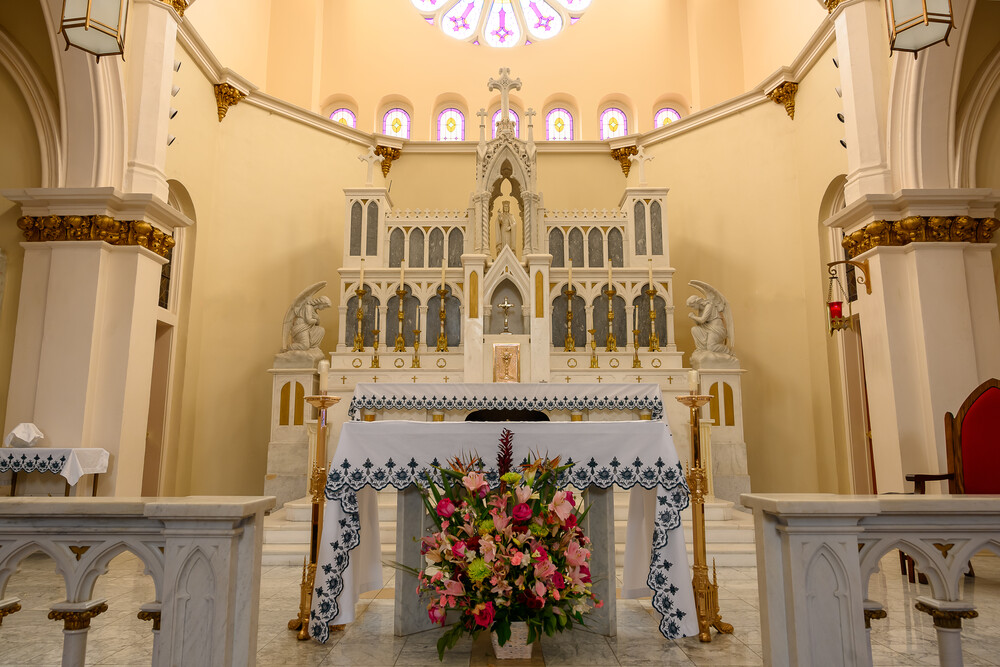 The interior of St. Joseph's contains numerous historically significant features. The main altar is made of American marble trimmed with Italian marble. This altar was installed in March of 1910 and was given in memory of Adam and Frances Clay, the first family entered in the church register in 1880. The altar was built by the Ott Memorial Company of Galveston. The Estey organ was once on display at the World's Fair in St. Louis.
On February 23, 1902, St. Joseph's was officially dedicated with a formal ceremony and address by Bishop Gallagher of Galveston. Immediately, St. Joseph's Church was recognized as an architectural asset for Houston.
Under Father Banfield's supervision, a rectory was constructed in 1911 on the parish grounds. The rectory is a white colonial two-story with wide side verandahs. A parish school building was also constructed in 1922. This building now house office for the Church.
During Father Banfield's tenure, St. Joseph's weathered the Depression of 1929 and remained open when many Houston churches has to close. after a long and creative life, Father Banfield died in September of 1938. He was succeeded by reverend Joseph P. Sullivan and later by reverend Lawrence Lee.
With Father Banfield's death and the changing ethic character of the neighborhood, St. Joseph's experienced a radical transformation. Church membership declined in the 1950s and 60s. And in 1967, St. Joseph's was forced to close its school due to dropping attendance. the parish, faced with numerous problems, was close to the wrecking ball.
Thankfully, Father Maurice Dho, who followed as pastor in July 1971, put the Church on solid financial standing. In addition, as the 75th. anniversary of St. Joseph's approached, members of the congregation, interested citizen, and the St. Joseph's Restoration Committee joined forces to restore the Church in 1974. During the restoration, a mural of the Resurrection was installed and the Society of Jesus (Jesuit Fathers) assumed responsibility of St. Joseph's Church. In 1977 St. Joseph's and the sixth Ward residents instituted a Multi-Ethnic Festival as a community effort.
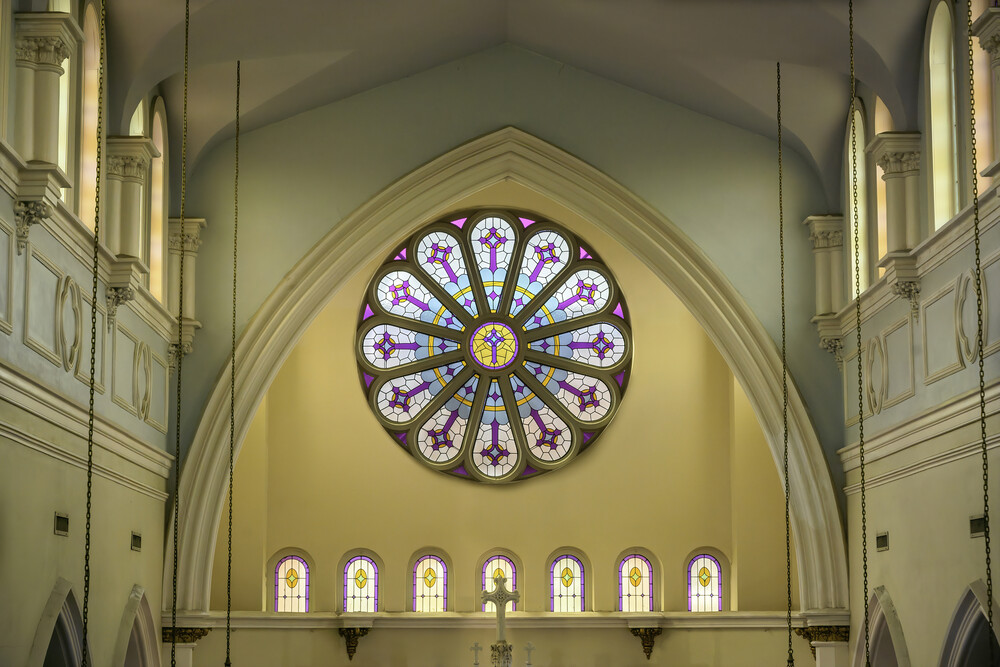 In 1911, a series of beautiful stained glass windows was added to the Church. The stained glass window project was an effort of a life member of the Church, Mr. F. A. Heiman. The windows are made of German glass and are perfectly matched to other windows in the Church. The Franz Myer Company of Munich, Germany, created all twenty-four memorial windows.
In 1980, the Church parish celebrated its 100th year. Five years later, 144 children, under supervision of Pio Pulido and Sylvia Orazco completed a 34 by 58 foot mural on the school building. The mural is entitled "A United Community." "And in 1988, St. Joseph's commissioned sculptor Eric Kaposta to design and construct a life-size bronze statue of St. Joseph. The statue was dedicated on August 21, 1988.
The first Catholic church built north of Buffalo Bayou and the second oldest existing parish in Houston, today St. Joseph's remains a Roman Catholic church serving a congregation made up of long-standing members as well as Black, Hispanic, and Vietnamese communities. The parish is a hub of community activities including a two-day multi-ethnic festival, a senior citizens nutritional center, a social service ministry, and a job placement program. In addition, the church sponsors a food distribution program for Houston's poor and hungry.
St. Joseph's is a model of inner-city church revitalization. It exists not only as a significant life force for Houston's inner city community, but also its interesting background and distinctive Romanesque style make it a valuable contribution to Houston's history, culture, and architecture.
In 1981, St. Joseph's Church was listed on the National Registry of History Places and in 1988 as a Texas Historic Landmark.